
September 18, 2026
UGC Platform for Agencies: Scale Creator Content without growing your team

UGC Platform for Agencies in Germany: Scale Creator Content Without Growing Your Team
A UGC platform helps marketing agencies find creators, manage briefs, collect client approvals, track content production, and run multiple UGC campaigns from one place. For agencies in Germany, the real value appears when UGC moves beyond a few one-off videos and becomes an ongoing service across multiple clients. Creonda brings that workflow together, from creator sourcing to final approval.
TL;DR
A UGC platform replaces scattered Instagram DMs, spreadsheets, emails, briefing documents, and file folders with one structured workflow.
For agencies, the size of the creator pool is only part of the equation. Multi-client management, white-label workflows, usage rights, approvals, and scalable operations matter just as much.
Creonda was developed from hands-on agency experience and is built for performance, growth, creative, social media, and marketing agencies working with UGC.
Agencies can browse creators for free without committing to a monthly platform subscription.
The biggest benefit appears at scale: agencies can manage more UGC campaigns without building a larger internal creator operations team.
Last updated: September 18, 2026
UGC looks surprisingly simple from the outside. Find a creator. Send a brief. Get a video. Done. Anyone who has coordinated five creators for three clients at the same time knows how quickly that tidy little process falls apart.
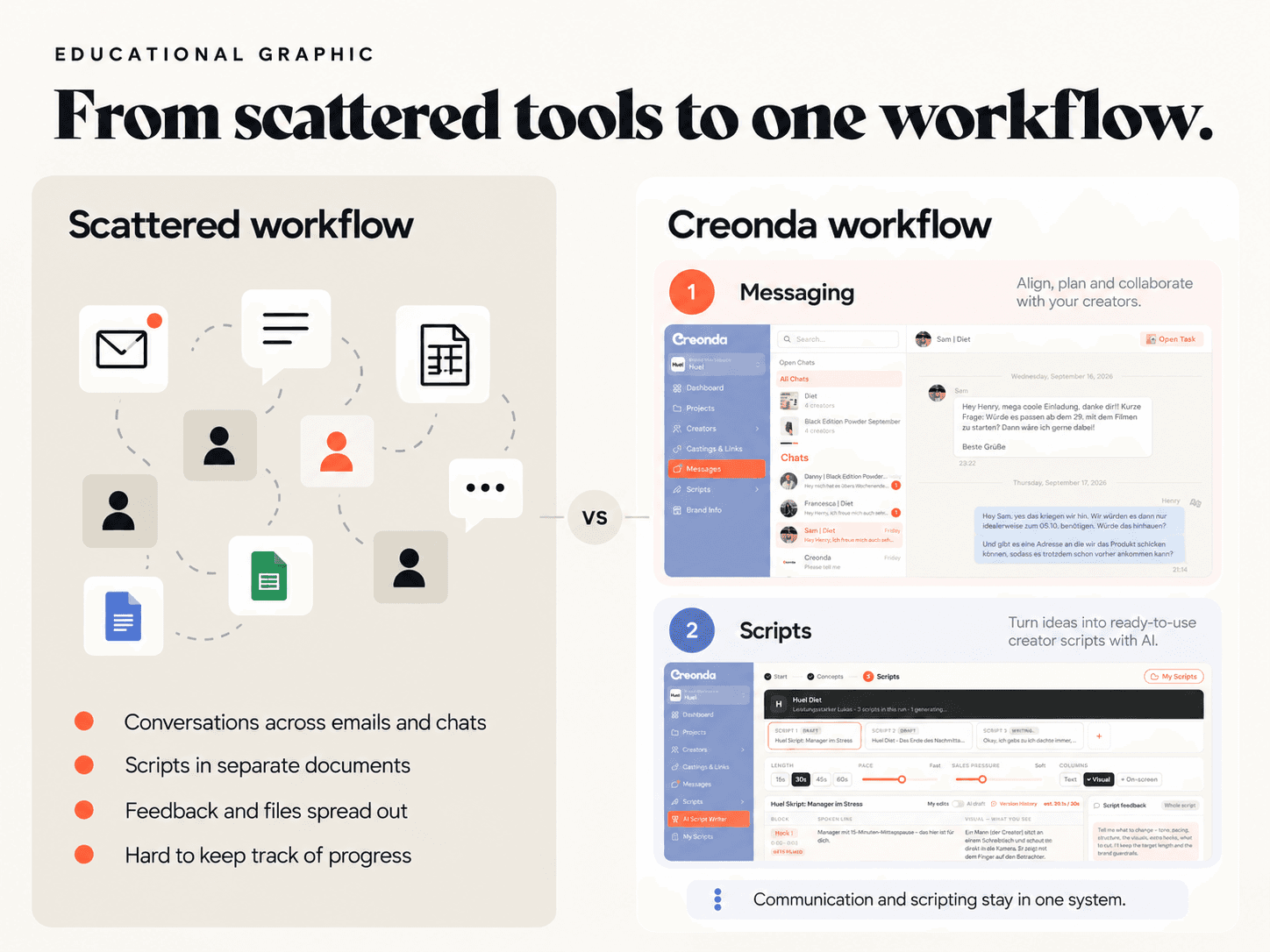
One brief lives in Google Docs. Client feedback arrives in Slack. Two creators are messaging the account manager on Instagram. Another prefers email. Someone has uploaded a third version of a video, but nobody is entirely sure whether version two or version three was approved. Then somebody asks the question that should have been answered two weeks earlier: How long are we actually allowed to run this video as an ad?That is the point where UGC stops being just a creative task and becomes an operational challenge.
At Creonda, we know that challenge from agency work. After years of working with UGC campaigns, one pattern became difficult to ignore: agencies rarely lack ideas.The bottleneck is everything that happens between the idea and the finished asset. That is exactly where a UGC platform should help.
What is a UGC platform?
A UGC platform is a centralized solution that helps brands and agencies find content creators, create briefs, organize communication, review content, and manage User Generated Content production. More advanced platforms go beyond creator discovery and help manage the complete workflow from sourcing to final delivery.
That distinction matters. A creator database can give your team a list of profiles. Useful? Absolutely. But finding a creator is only the beginning. You still need to check availability, agree on pricing, prepare the brief, organize product shipping, monitor deadlines, review scripts, collect client feedback, coordinate revisions, deliver final assets, and keep track of usage rights. For one video, a capable account manager can probably improvise. For 20, 30, or 50 assets every month? That gets messy fast. For agencies, a UGC platform therefore needs to work less like a digital address book and more like production infrastructure.
Why do marketing agencies need a different UGC platform?
Agencies need to manage multiple brands, campaigns, stakeholders, creators, and approval processes at the same time. That makes features such as multi-client workspaces, role-based access, white-label presentation, centralized communication, and structured client approvals particularly valuable.
Imagine a performance marketing agency in Berlin with eight retainer clients. Three clients decide they want to test UGC.At first, an account manager handles creator sourcing on the side. It seems manageable.A few weeks later, 15 creator collaborations are running simultaneously. Products are being shipped. Scripts need approval. Videos arrive on different days. Creators need feedback. Invoices need processing.Meanwhile, every client expects their campaign to feel like the only campaign the agency is managing.The agency has generated more revenue.I t has also quietly created a new operational department.That part often gets overlooked.
The bottleneck in scaled UGC production is rarely uploading a TikTok or Instagram Reel. It is coordinating all the people, assets, deadlines, rights, revisions, and decisions behind it. For a typical campaign involving five creators, Creonda estimates roughly 45 hours of internal work when the process is managed manually. Using its platform workflow, Creonda estimates that process at approximately 10 hours. Those figures come from Creonda's own workflow calculations rather than an independent industry study, so they should be treated as an internal benchmark. But they illustrate the real question agencies should be asking: How many client campaigns can our existing team manage before we need to hire another person?
What should agencies look for in a UGC platform?
A UGC platform for agencies should bring creator sourcing, briefing, communication, campaign status, client approvals, revisions, payments, and usage rights into a manageable workflow. Agencies should also look for multi-brand management, white-label capabilities, and appropriate access controls.
A huge creator marketplace sounds impressive in a sales presentation. In day-to-day agency work, it is not enough. Look at the complete journey from the moment a client asks for UGC to the moment the final asset is ready for launch.
Feature | Why agencies need it |
|---|---|
Creator discovery | Find relevant creators for different clients and audiences faster |
Vetted creators | Reduce uncertainty around quality and reliability |
Multi-brand workspace | Keep clients and campaigns clearly separated |
White-label workflow | Keep the agency-client relationship front and center |
Briefing tools | Reduce misunderstandings before production begins |
Central communication | Avoid scattered DMs, emails, and WhatsApp conversations |
Video feedback | Keep revision requests connected to the correct asset |
Roles and permissions | Give clients and team members appropriate access |
Usage-rights management | Keep commercial usage terms organized |
Payment workflow | Reduce creator administration |
Project status | See deadlines, deliverables, and outstanding actions in one place |
This is where a creator marketplace and a real production system begin to look very different.
If your project manager still needs five other tools after adopting a UGC platform, the core operational problem has probably just moved somewhere else.
How does Creonda's UGC platform work for agencies?
Creonda combines creator sourcing and UGC production with a multi-client workflow designed for agencies. Agencies can organize clients as separate brands, discover creators, prepare briefs and scripts, manage production, and involve clients in approval workflows while retaining control of the relationship.
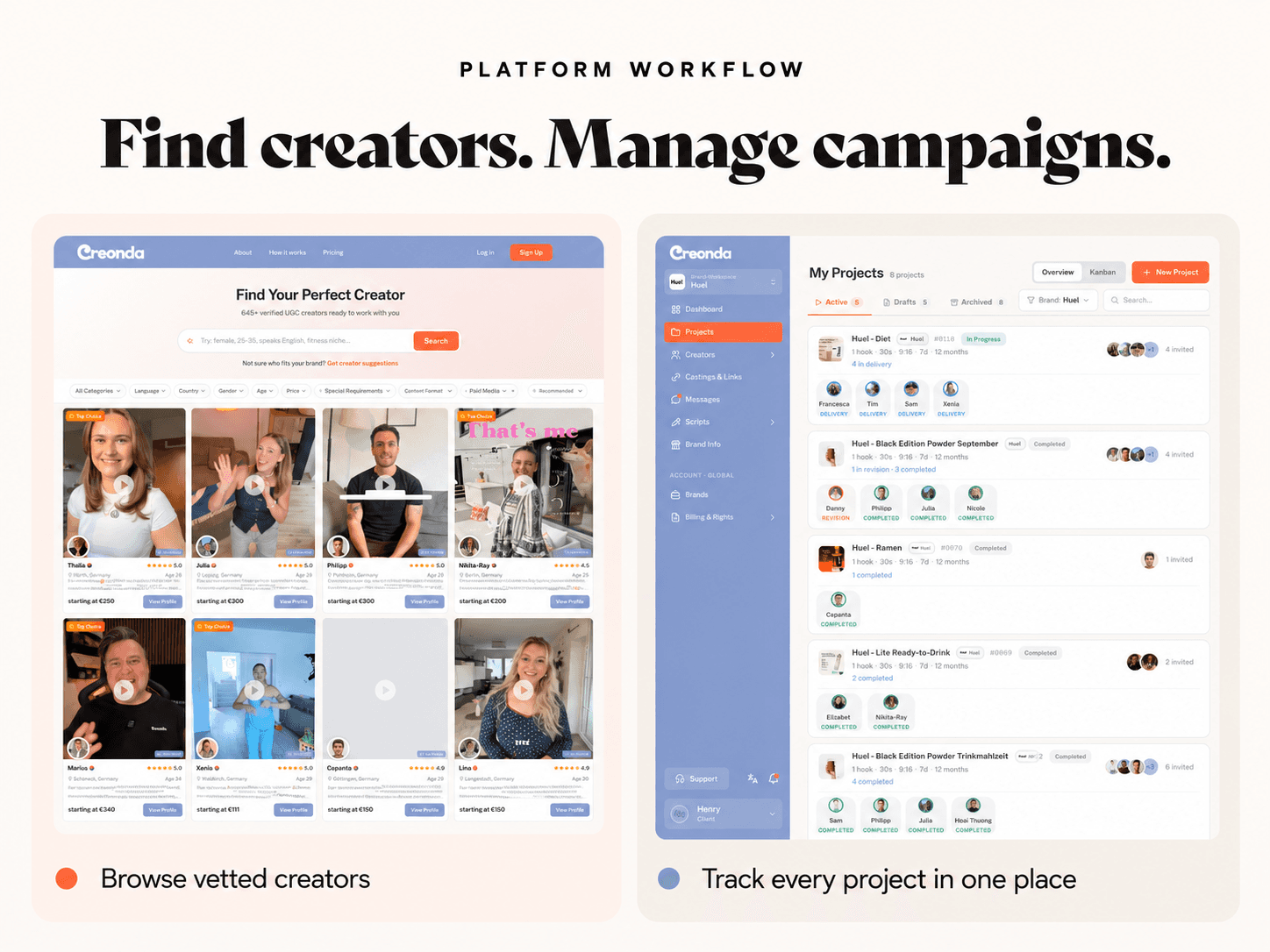
The process can start before an agency has committed to a campaign. Agencies can browse creators and see who may fit a particular client or pitch. That matters more than it sounds.
Picture this: you are presenting a proposal on Thursday afternoon and the prospective client suddenly asks: "Do you actually have German-speaking female creators between 30 and 40 who would fit our product?" Without a creator network, the answer is usually some version of: "We'll source them once the project starts."
With an accessible creator platform, your team can already explore relevant profiles. Once a campaign begins, clients can be organized as separate brands within the workspace. Teams can select creators, share options with clients, prepare briefs and scripts, follow collaborations, and review incoming content. The agency remains at the center of the client relationship. That is deliberate. Creonda positions its agency solution as white-label infrastructure. The agency keeps its strategy, client relationship, and commercial model while Creonda provides creator and production infrastructure behind the scenes.
For an agency that wants to sell UGC as its own service, that is fundamentally different from simply referring the client to another UGC provider.
Find creators for free on Creonda.
What does white-label UGC mean for an agency?
White-label UGC allows an agency to offer creator production as part of its own service while using external technology and creator infrastructure behind the scenes. The client continues working with the agency rather than being handed over to another provider.
At first, white labeling sounds like a branding feature. It is really a business-model feature. Consider a social media agency in Hamburg that already provides strategy, paid social, and creative services. A long-term client suddenly asks for 15 new UGC videos every month. The agency has three obvious choices. It can turn the work down. It can build an internal creator operations team. Or it can use outside infrastructure while retaining ownership of the client relationship.
With the third model, one detail becomes critical: the infrastructure provider should not suddenly start behaving like a second agency in front of your client. Creonda addresses this with an agency-oriented, multi-client environment and a no-compete positioning for agency client accounts. The agency remains the strategic partner. That makes white-label functionality much more than a cosmetic detail. It helps protect the agency's position in the value chain.
How can agencies find the right UGC creators?
Effective creator matching should go beyond follower count. Agencies should consider audience fit, language, demographics, content style, availability, reliability, and whether the creator can deliver a brief naturally. A UGC platform can make that selection process considerably faster.
One misconception about UGC refuses to disappear: UGC creators do not necessarily need to be influencers. If the final video will be published by the brand or used in paid advertising, a creator with a small personal audience may still produce an excellent asset. What matters is whether that person feels believable for the product, audience, and creative angle.
Suppose you are producing ads for a skincare company. You might not need a "beauty influencer with 100,000 followers." You might need a German-speaking woman in her early 40s who feels comfortable on camera, understands how to demonstrate a product, and doesn't make the final video look like a polished influencer sponsorship.
Very different search. A good creator platform helps narrow those choices quickly. Creonda combines creator filtering with AI-supported matching so teams can describe the type of creator they need rather than building every search manually.
The technology should speed up the shortlist. It should not replace creative judgment.Someone on your team still needs to look at the creator and ask: Would our customer's audience actually believe this person?
Why does creator sourcing become an agency bottleneck?
Creator sourcing scales poorly when agencies start every campaign from scratch. Searching TikTok, Instagram, portfolios, and personal networks takes time, and finding a profile is followed by availability checks, outreach, negotiation, and coordination. A platform turns that repetitive work into a more consistent process.
Finding one promising creator is relatively easy. Finding ten suitable creators for five completely different brands is not. That is where the hidden cost appears. One employee spends two hours on TikTok. Someone else has an old spreadsheet containing creators from last year's campaign. Fifteen DMs go out. Five people never reply. Three look promising but are unavailable this month. None of those tasks appear on the client's invoice as "production of one 30-second UGC video." The hours are still real. That is why agencies should not calculate UGC profitability using the creator fee alone.
Creator fee + platform cost + internal sourcing + project management + administration = actual production cost.
The last three categories are where margins quietly disappear.
How can a UGC platform improve creative testing?
A UGC platform can make creative testing faster by keeping new creators and assets moving through the production pipeline. Performance agencies can build a continuous supply of creative variations instead of waiting until an existing ad starts losing performance before ordering replacements.
Paid social teams know what happens. An ad works. Spend increases. Everyone is happy.
Then performance starts slipping and somebody realizes there is no replacement creative ready.
Now the next UGC production becomes urgent. That is usually not a strategy failure. It is a production-speed problem. For agencies running Meta, TikTok, and other paid social campaigns, UGC works better when it becomes a pipeline rather than an occasional order. Creator A records three different hooks. Creator B approaches the same offer from another angle. Creator C delivers the core message for a different customer segment. Suddenly, the brief is no longer "we need another video." You are building a creative testing system. That is where structured UGC production becomes particularly valuable for performance agencies.
How much does a UGC platform cost?
UGC platform pricing varies considerably. Some providers charge per video, others use subscriptions, commissions, or managed-service retainers. Creonda currently uses a model without a monthly platform subscription for brands and agencies and lists a 20% platform commission when a creator is booked.
That makes price comparisons less straightforward than they appear. Speekly, for example, currently lists on-demand creator videos starting at €119. It also offers managed services and the subscription-based Speekly OS product.
Creonda uses a different structure: no monthly platform subscription for brands and agencies, with a stated 20% commission on bookings. Neither pricing model is automatically right for every agency. Your workflow matters. An agency that needs one standalone video every few months evaluates a platform very differently from an agency running monthly creator production for eight clients. Before comparing prices, calculate:
Creator costs + platform costs + internal labor + administration = total UGC production cost.
Internal labor is easy to overlook because there is no separate invoice for it. It can still be the most expensive part.
Creonda vs. Speekly: What is the difference?
Creonda and Speekly both support UGC production, but their current offerings emphasize different workflows. Speekly offers on-demand videos, managed services, and its Speekly OS software. Creonda's agency proposition focuses more heavily on white-label, multi-client UGC infrastructure without a recurring monthly platform subscription.
Speekly is an established name in the German UGC market and provides a structured self-service approach. Its current pricing page lists on-demand videos from €119, a managed service from €2,000, and Speekly OS from €249 per month.
Creonda's agency proposition starts from a slightly different question. It is not simply: How can we order a UGC video?
It is: How can our agency operate UGC production for multiple clients without creating an increasingly complicated internal process? That distinction matters when comparing platforms. Don't look only at the price of one video. Ask whether the system fits the way you want your agency to work 12 months from now.
What should German agencies know about UGC usage rights?
Commercial UGC should have clearly agreed usage rights. Under Section 31 of Germany's Copyright Act (UrhG), rights of use can be granted on a simple or exclusive basis and may be limited geographically, temporally, or by content. Agencies should therefore know where, how long, and for what purpose an asset may be used.
This is one of those details that teams often postpone until the end. Be careful with that. Permission to use a video organically on Instagram does not automatically mean every conceivable paid-media use has been granted forever. The actual rights depend on the agreement between the parties. Agencies also have an additional layer to consider. The creator, agency, and end client need a rights structure that works together. If an ad performs exceptionally well and the client wants to keep running it, nobody wants to discover that the usage period was buried in an email from six months ago. Usage rights should be part of the production workflow, not an afterthought.
Legal note: This is general information and not individual legal advice.
Does UGC need to be labeled as advertising in Germany?
Commercial social media content may require advertising disclosure in Germany. Germany's media authorities recommend that commercial content be labeled in a way that allows users to recognize its advertising nature immediately. The exact requirement depends on how the content is produced, published, and used.
A video does not stop being commercial simply because it looks like an ordinary smartphone clip. That distinction between visual style and legal status matters.
The German media authorities' current guidance covers advertising disclosures across platforms including Instagram, YouTube, and TikTok.
For agencies, the practical lesson is simple: consider disclosure requirements and intended usage during campaign planning.
Not five minutes before publication.
For campaign-specific legal questions, seek qualified legal advice.
What mistakes do agencies make when scaling UGC?
The biggest mistake is treating UGC as a collection of individual freelancer jobs rather than a repeatable production process. That can work at low volume, but with multiple clients it often leads to scattered communication, unclear ownership, outdated creator lists, and rising internal costs.
The pattern is familiar. An agency builds a huge creator spreadsheet. Three months later, half of it is outdated. Account managers run parallel WhatsApp conversations. Briefs are copied from old campaigns. Usage rights live somewhere in an email chain. Client feedback arrives in Slack, while the creator is waiting for instructions somewhere else.
Each individual workaround seems harmless. Together, they create a system that works only because one person on the team remembers where everything is. Then that person takes two weeks off. Suddenly everyone discovers there was never really a system. There was just somebody who was very good at improvising. A UGC platform should reduce that dependency.
When does a UGC platform make sense for an agency?
A UGC platform becomes especially useful when an agency regularly produces creator content for multiple clients or wants to turn UGC into a scalable service. As creator, client, and asset volume increases, centralized workflows and clear ownership become increasingly important.
Not every agency needs a platform immediately. If you produce two creator videos per year and already know two reliable freelancers, your existing process may be perfectly adequate. The equation changes when UGC becomes part of a monthly retainer. Now you don't just need to deliver five videos today.
You need to know how you'll deliver 20 next month and perhaps 50 later without watching your margin disappear into project management.
Ask your team:
How many hours do we spend sourcing creators each month?
How many tools sit between a client brief and the final asset?
Can clients approve content in one place?
Can we immediately identify the approved version of every asset?
Are usage rights and expiration dates easy to find?
Could we onboard another UGC client without hiring someone?
Does our agency remain the clear client-facing partner?
If several answers make the room go quiet, you probably don't have a creator problem. You have an infrastructure problem.
How can agencies get started with Creonda?
Agencies can start by browsing creators on Creonda for free and checking whether the creator network fits their client requirements. Campaigns can then be organized through the platform when suitable creators are found, without requiring a monthly platform subscription under Creonda's current pricing model.
There is no need to redesign your entire agency workflow overnight. Start with one real campaign. Find five to ten creators who fit the brief. Compare how long that takes against your normal sourcing process. Then run the production and pay attention to more than the final video. How many messages did the team need to send? How quickly did the client approve creators and content? Was the campaign status obvious? How much time did your account manager actually save? Those numbers will tell you more about the value of a UGC platform than a long feature list ever will.
Find creators for your next client campaign
If your agency already sells UGC — or wants to add it without building an entire creator operations department — start by seeing who is available.
Browse UGC creators on Creonda for free. No monthly platform subscription. Find the right creator first, then decide whether to start a campaign.
People Also Ask
What is the best UGC platform for agencies in Germany?
The right UGC platform depends on the agency's business model. Agencies managing multiple clients should pay particular attention to multi-client workflows, white-label options, creator sourcing, approvals, and usage-rights management. Creonda is designed to support agency workflows and currently operates without a monthly platform subscription for brands and agencies.
How do I find UGC creators in Germany?
Agencies can find German UGC creators through creator platforms, social media, referrals, and direct outreach. Specialized platforms make the process faster by centralizing creator profiles and campaign workflows. Creonda allows agencies to browse vetted creators and use matching tools to identify profiles relevant to specific client requirements.
How much does a UGC creator cost in Germany?
There is no universal UGC creator rate. Pricing varies according to the creator, format, video length, production requirements, usage rights, hooks, and additional deliverables. Agencies should calculate creator fees together with platform charges and internal sourcing and project-management time to understand the true cost of production.
Can marketing agencies offer UGC as a white-label service?
Yes. A white-label model allows an agency to remain the main client contact while creator sourcing and production infrastructure operate behind the scenes. This can help agencies add UGC to existing social media, performance marketing, or creative retainers without building every operational component internally.
Do I need a subscription to use a UGC platform?
It depends on the provider. Some UGC platforms use monthly or annual subscriptions, while others charge per production or transaction. Creonda's current model for brands and agencies does not include a monthly platform subscription and instead applies a commission when creators are booked.
Can agencies manage their existing creators through Creonda?
Creonda includes a "bring your own creators" approach within its agency proposition. This allows agencies to combine existing creator relationships with new creator sourcing and manage production through a more centralized workflow rather than limiting the platform to newly discovered creators.
FAQs
Is UGC only useful for TikTok?
No. UGC can be produced for TikTok, Instagram Reels, Meta Ads, landing pages, product pages, and other digital touchpoints. The important questions are format, audience, intended placement, and usage rights. Performance teams often create several hooks or variations from one production to support ongoing creative testing.
What is the difference between a UGC creator and an influencer?
Influencers are often hired partly for access to their existing audience. UGC creators are primarily hired to produce content. The brand can then publish or advertise that asset through its own channels, depending on the agreed rights. A strong UGC creator therefore does not necessarily need a large following.
How quickly can UGC be produced?
Production time depends on creator availability, shipping, brief complexity, revisions, and the type of asset required. Creonda currently communicates a workflow capable of producing UGC ads in around seven days. Agencies should also consider the time needed for creator selection, client approvals, and revision management.
Can an agency manage several clients through one UGC platform?
Yes, provided the platform supports multi-client or multi-brand management. Creonda's agency workflow allows different client brands and access levels to be organized within the platform, reducing the need to manage every campaign through separate spreadsheets, chats, and project-management tools.
Should an agency source creators manually or use a UGC platform?
Manual sourcing can work well for occasional campaigns. As the number of clients, creators, and monthly assets increases, however, sourcing and coordination become substantial operational tasks. A platform becomes valuable when the time saved on discovery, communication, approvals, rights, and project management outweighs its cost.
About the Author
Andrea de la Torre
Founder of Creonda
Andrea de la Torre is the founder of Creonda, a UGC platform built to make creator sourcing and content production easier to manage for brands and agencies. Creonda grew from hands-on experience with UGC campaigns and the recurring challenge of coordinating creators, briefs, communication, approvals, and production across disconnected tools.
Reviewed by: Creonda Editorial Team
Last reviewed: September 18, 2026
Disclaimer
The sections discussing copyright, usage rights, and advertising disclosure provide general information about UGC campaigns in Germany. They do not constitute legal advice. Legal requirements may vary depending on the campaign, contractual arrangements, publication method, and specific circumstances.